Beyond the Runway: How Junk Kouture Helped Maha Shahzadi Find Her Voice
Junk Kouture alumna and Future Leader Maha Shahzadi reflects on how a sustainable fashion competition became an unexpected journey of identity, belonging and self-expression. From struggling to fit in after moving to Ireland from Pakistan to embracing her South Asian heritage on a global stage, Maha shares how Junk Kouture helped her discover the confidence to be unapologetically herself.
Finding My Place
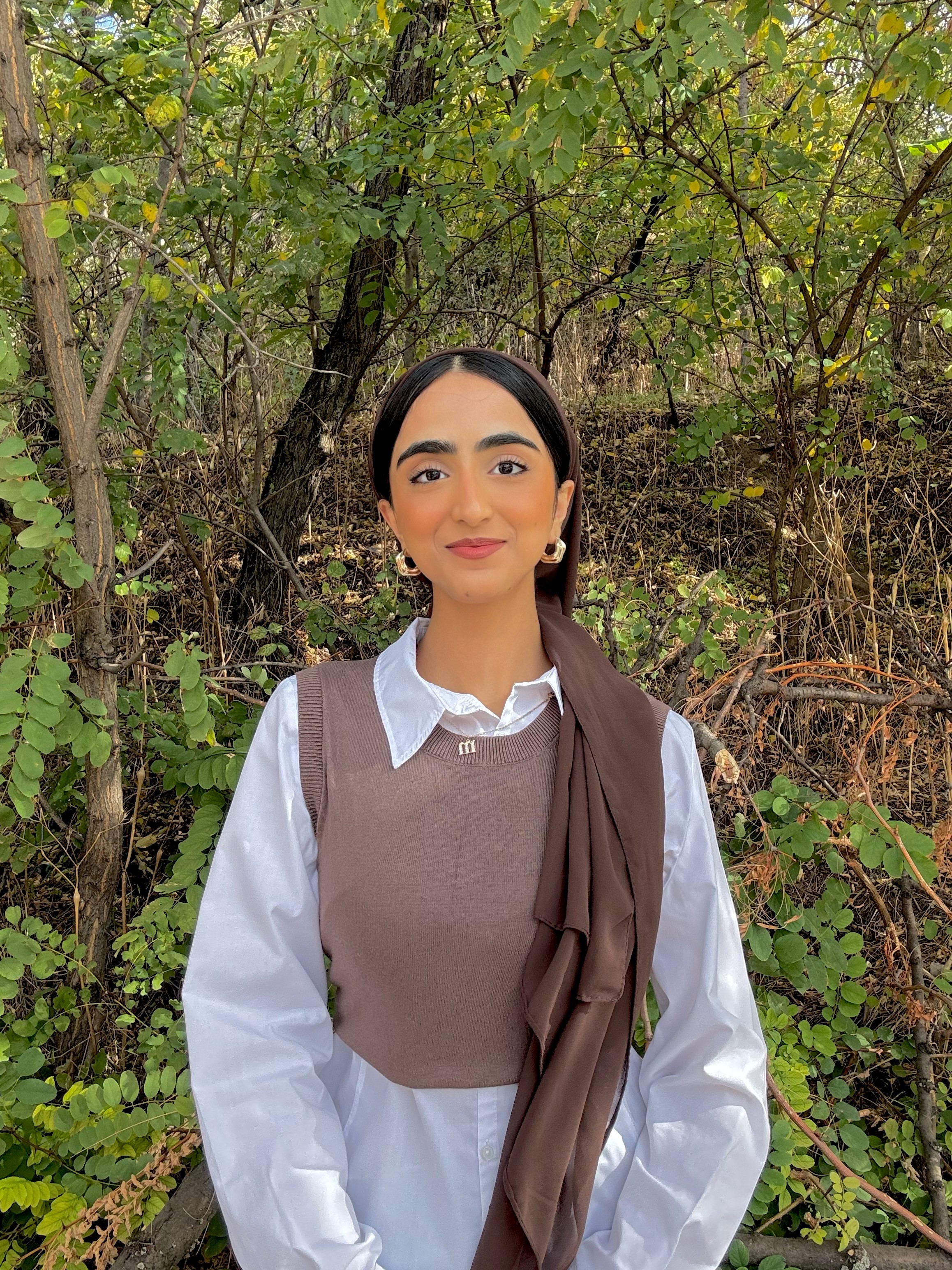
I’m not the usual Junk Kouture kid most people would imagine me to be. I am not a ‘creative’; fashion design is not something I want to pursue as a career, and while I care about sustainability and the environment, it is not something that is central to the work I do. And yet, the design I made (with the support of my team members Jadine and Somaia) ended up on a global stage in Abu Dhabi, featured on the National Late Late Show and became part of a JK documentary, “Behind the Seams”, which aired on RTÉ.
Hi! My name is Maha Shahzadi, and on the surface, I am not exactly the kind of person you would envision when speaking about Junk Kouture. I am a traditional science kid, pursuing a career in medicine; I didn’t do art in school, and if you look at enough photos of me, you’ll very quickly realise I don’t really have much of a unique fashion taste either. However, this is exactly what I believe most people get wrong about the Junk Kouture community. The JK community is not confined to a single niche group of people. It's multidimensional, made up of young people from all walks of life, united by a single emotion: the feeling of ‘not fitting in’.
I wasn’t born in Ireland. I moved here from Pakistan at the age of nine. Ireland: a developed country, Christian majority, the Global North. Pakistan: a developing country, Muslim majority, the Global South. As you can imagine, the two countries are polar opposites of each other, so trust me when I say, I know the feeling of ‘not fitting in’ a little too well.
I vividly remember being in primary school, intently observing everyone around me, trying to make sense of a world that suddenly felt unfamiliar. I remember the moments when I felt frustrated, frustrated that I couldn’t understand what the teacher was saying because their words came out faster than what my untrained ear could process. I remember the times I used to skip lunch because I felt too embarrassed to eat the food I had brought from home. Back then, I never thought twice about bringing my favourite South Asian dishes to school; they were simply the food I had grown up with and loved. But after learning that they 'smelled too strong’ and looked ‘disgusting’, I began to look at them differently. Things that once made me feel at home were now things that I felt I needed to hide.
And so, I learned, learned to adapt, learned to edit. I studied the other kids, observed how they spoke, how they behaved and how I was expected to fit in. And somewhere along that journey, I became so skilled at tailoring myself to my surroundings that I didn’t realise how much of me I had adapted away, something I only came to learn about myself when I decided to take part in Junk Kouture. I entered the competition thinking, ‘this would be a fun little challenge’, unaware that I was about to embark on what I would probably classify as one of the most life-changing experiences I’ve ever had to date.
Learning to Think Outside the Box
As I began my journey, I discovered pretty quickly that Junk Kouture wasn’t exactly like the other science competitions I had entered previously. It didn’t operate in a conventional manner where there is a template to follow and a very defined form of success. Rather, JK felt like a temporary society with totally different rules. A society where being different isn’t a liability, but rather your greatest asset.
I remember coming to this realisation early on in my journey. Submissions were due in three months, and I was still stuck at the ideation stage of the design cycle. I was struggling to come up with manipulation techniques for my JK materials. At this point, my mentor had rejected my proposals five times on the grounds of ‘this has been done before’. And she was right. I was trying to make something that I thought would look like a JK design, getting my ideas from Pinterest and designers I knew of online, ‘reputable sources’ as they say in the science world. But really, subconsciously, I was trying to make something that would be accepted. And it wasn’t working.
My mentor kept encouraging me to ‘think outside the box’, unaware that I had spent the last five years of my life, trying to ensure that I fit within it. The whole no template, no checklist, no ‘do this, this and this and you will succeed’ situation, which is technically supposed to make people feel empowered to be their authentic selves, instead made me feel completely overwhelmed: ‘Wdym think outside the box!?’.
So for the sixth time, when my mentor gave me the final chance to prove myself, I went home and just cried. I had spent days staying up until 3 am, researching and refining my design only for it to get rejected again and again. I told myself I wasn’t ‘creative enough’ to do this project, but really, that was an excuse I was using to hide and save myself from confronting a deeper issue: fear of being seen, for me.
The Freedom to Be Myself
This is what I believe to be the greatest distinction between Art and Science. Science is objective. A separate entity from the scientist behind it. It's easy to excel in it without the whole thing having anything to do with your personal identity. Art, on the other hand, is subjective. It's personal. An extension of the artist that created it, exposing parts of you to the world that you might otherwise keep hidden. Science is facts; Art is an expression.
I think it was this moment that made me realise just how much I came to fear being seen for me, because coming up with an original design wasn’t really the issue; it was the uncertainty of whether what I created would be accepted. I had spent years building an identity that relied on external acceptance. Following instructions, reading expectations, and moulding myself into whatever people needed me to be that now, despite having the space to be unapologetically me, I was terrified. Terrified of how I’ll be perceived. However, the irony of the whole situation was that despite ‘playing it safe’, I was still being rejected.
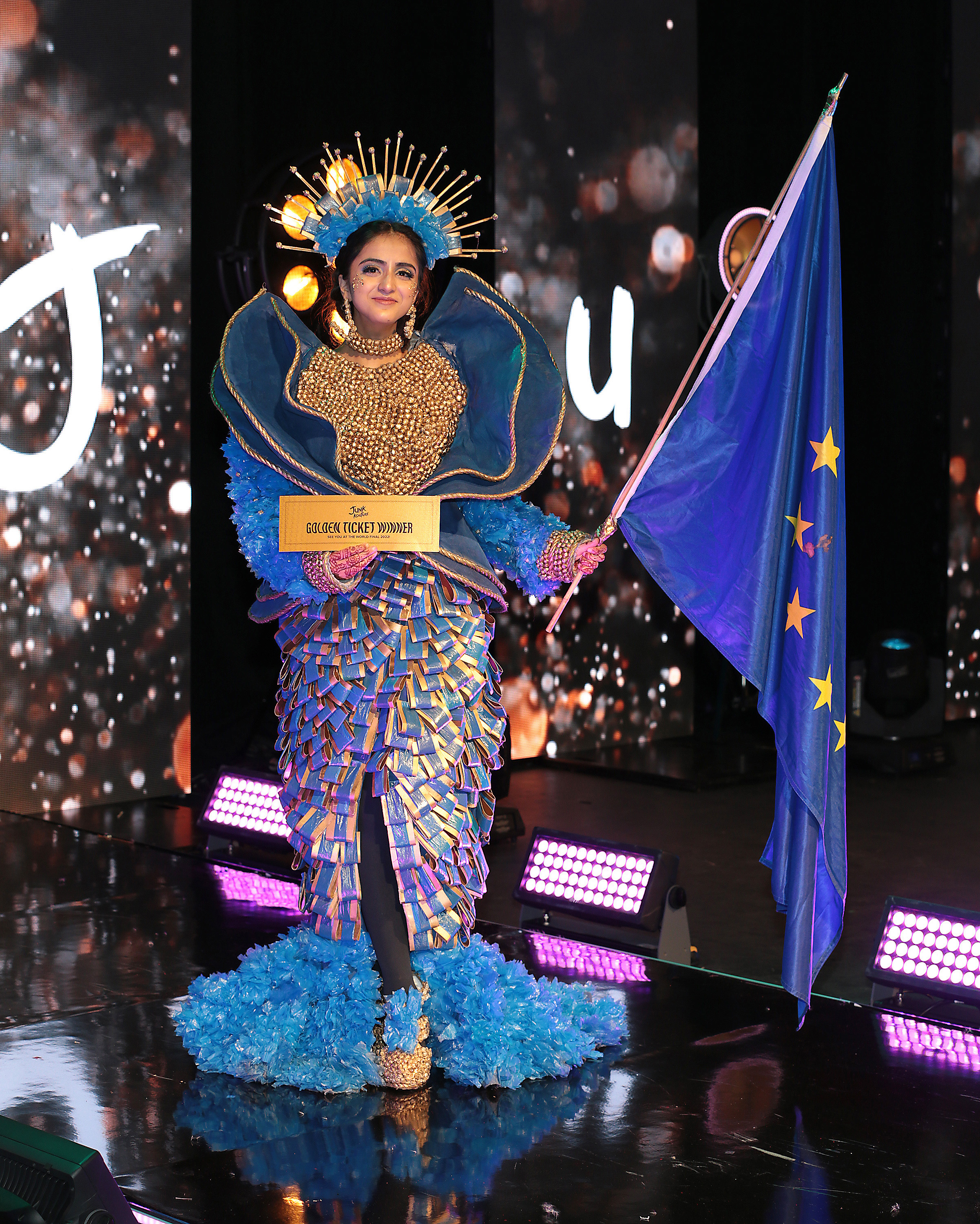
So after a nice thirty-minute session of ugly crying, I put on my earphones, blasted my favourite music and just played with the different materials. What would I create if nobody was watching? The answer, in retrospect, was a south asian core look. Bright colours (MUST HAVE GOLD), detailed patterns, some sort of beadwork, a structured majestic silhouette that brings the attention to the beauty of the garment itself, rather than on the size and shape of the body wearing it. And of course, has to have matching jewellery to go with it. Ideally gold. Did I mention the colour gold to be an important detail? Okay, you get the point.
I didn’t consciously set out to create a South Asian fashion-inspired look; rather, these were just things I gravitated toward when I stopped looking outward for what was appropriate and started creating what I genuinely loved in fashion. The result? The dress became a metaphor for my personality. An EU-themed outfit, reimagined through a South Asian lens, combining the two worlds I had spent so long trying to reconcile. And to have that, later, be celebrated at a global stage made me realise that there is a space for me to be me; for my differences, for my culture, for my dreams.
Beyond Junk Kouture
It's been four years now since I took part in the Junk Kouture competition, and as cliché as it may sound, I haven’t really been the same person since. No, I haven’t started a fashion brand or taken over the world (for now, anyway ;) but what I have become is someone who is not afraid to express herself, even when it comes with the cost of rejection. Someone who is bold enough to try new ideas or take the road less travelled. Someone who practises her dual identity loudly and refuses to allow anyone to make her feel as though that is a character flaw.
That is the person I am taking into medicine. I know what it feels like to sit in a room and quietly edit yourself, and I want every patient who walks into mine, whatever their background, accent or lunch, to never feel like they have to.
The Quiet Power of Junk Kouture
But this isn’t just my story. Each year, hundreds of young people take part in the JK competition for various reasons. For some, it is a debut in their fashion career. For others, it's an avenue to connect with other creatives. And for people like me, who never saw themselves in that room at all, it becomes something else entirely: the first place they feel allowed to stop editing themselves.
Whatever brings them through the door, they are handed a pile of discarded materials and asked to make something that is entirely their own. And somewhere along the way, many of them discover that the parts of themselves they had written off as too different, too loud or too much were never actually the problem. That is the quiet power of Junk Kouture. It teaches young people that their strength lies in whatever makes them different. If they can turn a piece of junk into couture, they can reshape the way they see themselves and the world around them.
Written by Maha Shahzadi, Junk Kouture Alumna and Future Leader.